
SoCal's Aerospace Boom Is Real. So Is the Talent Gap.
LA County pulled in $15B in defense contracts last year. Winning the work turned out to be easier than staffing it. Here's what founders, floor managers, and HR leaders need to do now.
Southern California's defense and aerospace sector is having a moment. Los Angeles County alone pulled in roughly $15 billion in defense contracts last year, and major programs are advancing fast — the Boeing-Anduril mid-range interceptor just moved into its next competition phase with the U.S. Army. If you're a startup founder who just landed a subcontract, a floor manager staring at a production schedule that assumes headcount you don't have, or an HR manager fielding urgent hiring requests from three directions at once, you're all looking at the same problem from different seats: winning the work turned out to be easier than staffing it.
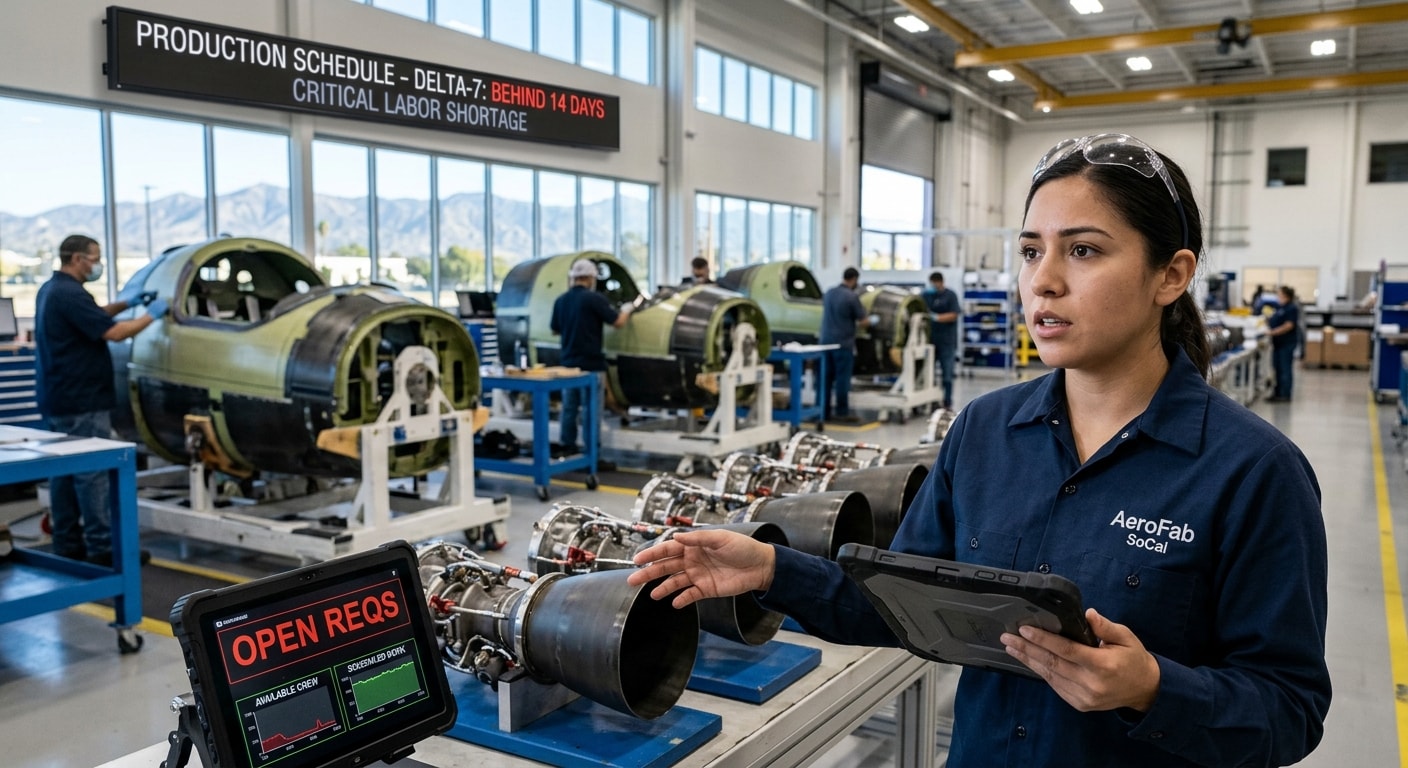
For floor managers, this shows up as open req after open req that HR can't fill fast enough, overtime that's becoming the norm instead of the exception, and a growing gap between what the schedule says and what the crew can actually run. For founders, it shows up as a delivery date that looked comfortable at signing and now looks aggressive.
Machinists, quality engineers, and skilled technicians are in short supply across the region, and the pipeline of new talent hasn't kept pace with the sudden surge in demand. A funding boom doesn't create a workforce — it just puts a spotlight on whether you already had one.
This is the moment where workforce planning stops being an HR checkbox and becomes a shared responsibility across the leadership table. Founders need to stop treating headcount as a line item to solve after the raise closes. Floor managers need a direct line to whoever owns hiring, not a ticket queue. And HR managers need the authority — and the data — to say 'we can't staff that timeline' before the contract is signed, not after the crew is already burning out.
I've watched this play out before: the crunch always arrives faster than anyone expects, and by the time it's obvious, the good candidates are already working for a competitor down the freeway.
Founders: Build headcount into the contract math, not after it. Before you bid or accept the next contract, model out whether you can actually staff the delivery timeline — not just whether you can afford to. If the answer is uncertain, that uncertainty belongs in the negotiation, not the post-award scramble.
Floor managers: Get your staffing gaps in writing, early and often. A weekly one-pager showing scheduled work versus available crew turns 'we're short-handed' from a complaint into a decision leadership has to act on. Numbers on paper move faster than verbal updates in a hallway.
HR managers: Invest in retention before you need to backfill. In a tight skilled-labor market, keeping your best machinists and engineers is cheaper and faster than replacing them. Audit pay, career paths, and burnout risk now — not after your best people give notice. Exit interviews after the fact tell you what you already missed.
Bring in senior HR leadership before the crunch hits, not during it. Whether that's a full-time hire or a fractional HR leader, the goal is the same: someone whose full-time job is watching this problem before it becomes everyone's emergency.
The companies that win in this environment won't be the ones with the biggest contracts — they'll be the ones where founders, floor managers, and HR are working off the same staffing picture instead of finding out about the gap at three different times. Workforce planning isn't a back-office function right now. It's the thing standing between a great year and a very public miss.
Need help building that workforce plan before the talent crunch hits? Visit hr-lead.com to schedule a consultation.
Stay current on practical HR guidance
Get new HR and leadership articles delivered to your inbox.
Ready to take the next step?
Schedule a consultation with Dr. Herb Callahan and the HR-Lead team.